
- FOX 7 and Univision 62 transmit on VHF; many slim antennas struggle with VHF.
- Federal rules protect your right to an antenna on property you control.
- Keep any mast at least 1 1/2 times its height from power lines.
Free TV in Austin depends more on where you live than on what you paid for the antenna. A cheap flat antenna can pull in every station in a second-floor apartment east of downtown, while a house tucked into a canyon west of Loop 360 may need an outdoor antenna aimed carefully over the next ridge. Here is how to work out what you need.
Start with the band, not the brand
TV signals travel on two bands, VHF and UHF. FOX 7 Austin puts it simply on its antenna help page: it broadcasts on channel 7, which is in the VHF band, so viewers should make sure an antenna is VHF-compatible before buying. The FCC’s public files show one more Austin station on VHF, Univision 62, licensed as KAKW on RF channel 13. The rest of the main stations, including KXAN, KVUE, KEYE and Austin PBS, transmit on UHF.
| If you want | You need |
|---|---|
| FOX 7 or Univision 62 | An antenna rated for VHF as well as UHF |
| Only the UHF stations | Almost any modern antenna, placed well |
| Stations from San Antonio or Killeen | An outdoor antenna, aimed, and patience |
Terrain is the Austin variable
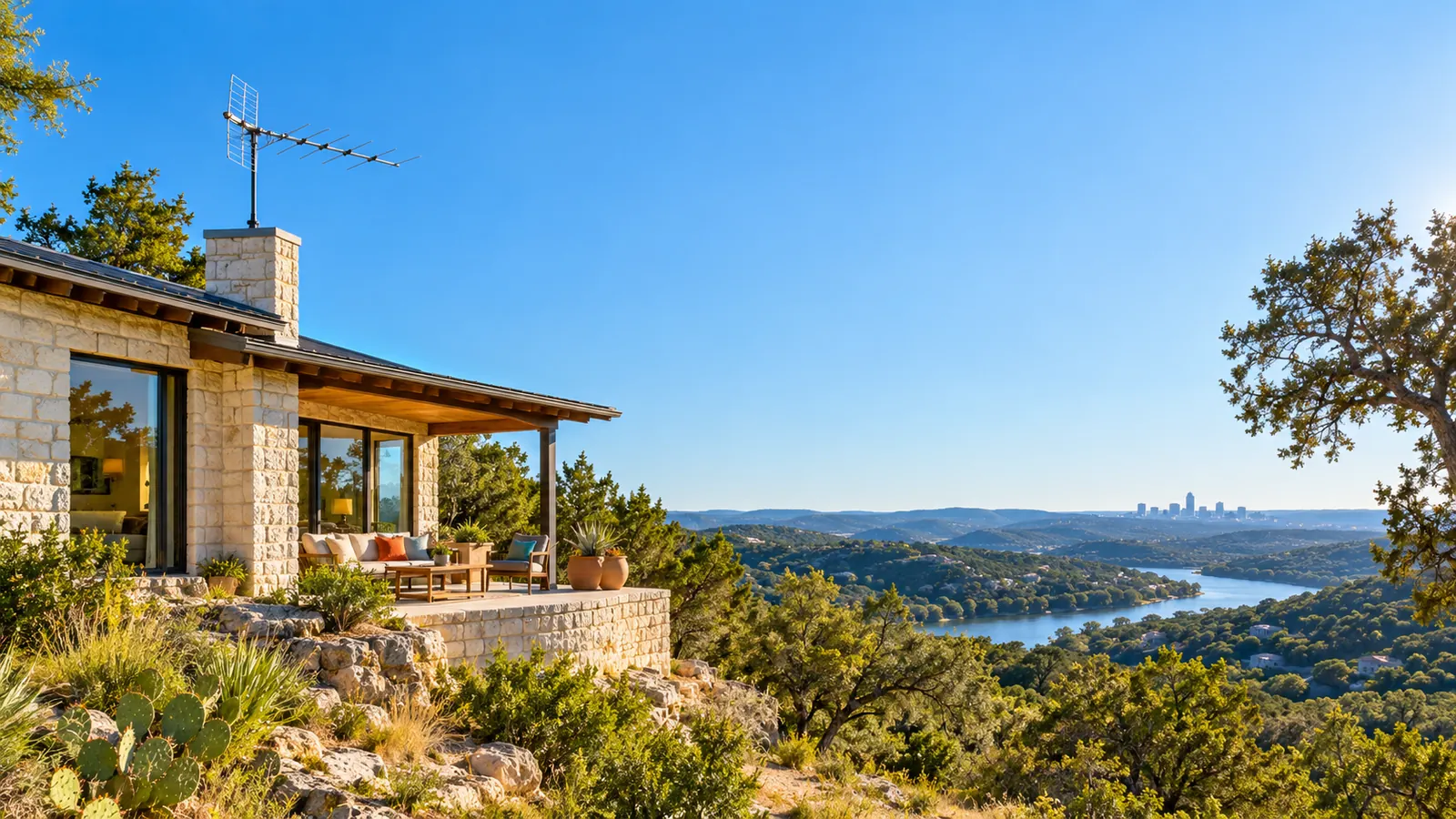
TV signals travel best in a straight line. On the prairie east of the city there is little in the way. West of town, the Balcones Escarpment and the Hill Country put hills, ridges and canyons between many homes and the transmitters. Two houses a block apart can get very different results because one sits on a ridge and the other in a draw. That is why the same antenna earns rave reviews from one neighbor and returns from another.
- On high ground or east of I-35: start with a flat indoor antenna in a window.
- In a valley or behind a ridge: go straight to an attic or outdoor antenna.
- Far out in the Hill Country: an outdoor antenna as high as you can safely mount it.
Tip: Before buying anything, ask a neighbor with an antenna which stations they receive and where the antenna points. In hilly areas, that is better information than any map.
Placement
- Indoors, use a window, as high as possible, away from metal blinds and appliances.
- Rescan after every move; FOX 7 notes a scan should take a couple of minutes.
- Try both sides of the house if stations come from different directions.
- Attics work well in many Austin homes, but metal roofs and foil-backed radiant barriers can block signals; scan before you commit.
Your right to an antenna
If you live in a neighborhood with a homeowners association, it may have rules about what goes on a roof. Federal law limits them. The FCC’s Over-the-Air Reception Devices rule, 47 CFR 1.4000, prohibits restrictions by local governments, landlords and homeowners associations that impair the installation, maintenance or use of an antenna for receiving TV broadcast signals, along with its mast, on property within your exclusive use or control where you have an ownership or leasehold interest. A rule impairs reception if it unreasonably delays or prevents installation, unreasonably increases the cost, or prevents an acceptable signal.
The rule has exceptions for clearly defined safety objectives and for properties on or eligible for the National Register of Historic Places, and it does not cover common areas you do not control. An HOA can still ask for reasonable placement; it cannot effectively ban the antenna.
Rooftop safety
The Consumer Product Safety Commission warns that antennas and ladders touching overhead power lines cause electrocutions. Its advice: keep masts, poles and ladders far from power lines, keep the distance from an antenna or pole to a power line at least 1 1/2 times the height of the antenna or pole, never assume a line is insulated, and properly ground all masts according to electrical codes. If the only good spot is near the service line to your house, hire a professional.
Weather on the roof
Central Texas roofs take hail, high summer heat and strong thunderstorm winds. Use a mount rated for the antenna’s size, fasten it to framing, seal every penetration and check it after big storms. Plan the work for a calm, cool morning rather than a July afternoon.
When to give up on the antenna
If you have tried a good outdoor antenna and still cannot get a station, the problem is probably the terrain. Most stations stream their newscasts for free; How to Watch Austin Local News Without Cable explains how. For the full channel list, see Austin TV Channels: The Local Stations You Can Watch for Free.
Finally, keep the receipt. Antenna results are hard to predict in hilly terrain, and the only real test is your own living room. Try the antenna in several spots over a couple of days before deciding whether to keep it.